What is Odoo OCA, and how does it work?
If you run Odoo Community, or you are weighing Community against Enterprise, you will run into three letters: OCA. It stands for the Odoo Community Association, and it is one of the reasons Odoo's open-source edition is so capable. Here is what OCA is, how it works, and how to get value from it without stepping on a rake.

What is Odoo OCA?
The Odoo Community Association (OCA) is a nonprofit organisation that supports the collaborative development of Odoo and promotes its open-source edition. Developers, integrators, and companies work together to build and maintain free modules that extend what Odoo can do, without relying on the Enterprise edition.
In practice, OCA is a large community and a set of shared code. Its work expands the ERP's capabilities and keeps the open-source ecosystem stable and sustainable, aligned with the interests of the users who depend on it. If you are new to the platform itself, start with why we choose Odoo.
OCA's mission and values
The goal is a collaborative, professional, high-quality ERP environment that anyone can use. Three values carry it:
Collaboration. Developers worldwide share knowledge and improve the platform together.
Open innovation. Modules answer real market needs, without commercial restrictions, so the ERP keeps evolving.
Transparency and open access. The tools are free to the whole community, so even small companies get more out of Odoo.
OCA vs official Odoo: Community and Enterprise
A common misunderstanding: OCA is not a separate version of Odoo. Odoo comes in two editions. Odoo Enterprise is the paid, proprietary edition, with official support and premium features. Odoo Community is the free, open-source edition. OCA sits around Community: it produces free, open-source modules that add functionality on top of it.
Both editions share the same foundation. What OCA adds is customisation and flexibility without licence fees, which appeals to companies that want to shape the system to their processes at a lower cost. The trade-off is that you take on more responsibility for choosing, testing, and maintaining those modules, which is where a partner comes in.
OCA apps: free, collaborative modules
OCA modules are community-built applications you add as you need them. The catalogue is broad. The most used areas:
• Accounting and invoicing. Accounts, invoices, and bank reconciliation, tied into the general ledger.
• CRM and sales. Customer management, opportunity tracking, and marketing automation.
• Inventory. Stock control, order tracking, and warehouse management.
• HR. Employee management, absences, scheduling, and training.
• Projects and tasks. Planning, task assignment, and progress tracking across teams.
Why teams use them
Value for money. Free, open-source modules mean advanced features without costly custom development from scratch.
Flexibility. Open source means a module can be adapted to your process and integrated with other systems.
An active community. Regular updates, security fixes, and collective support keep modules stable over time.
Where to find OCA modules
Most OCA modules live in public GitHub repositories at github.com/OCA. They are organised by area, for example accounting, CRM, or project, and each module ships with documentation, tests, and often practical examples. The community also maintains forums, security advisories, and installation guides, which makes the modules easier to adopt and vet.
How OCA modules get into your Odoo
The mechanics are straightforward for a technical user: take the module from GitHub, add it to your Odoo instance's module path, update the app list, and install it. On Odoo.sh you add the repository to your project; on a managed platform, your partner deploys it.
The catch is not the install. It is the upkeep. Community module quality varies, and not every module is maintained for every new Odoo release. Install the wrong one and a yearly upgrade can break. This is where we earn our place: we pick the modules worth using, test them against your setup, and keep them working through each upgrade. See how we customise and integrate Odoo.
Why use OCA in your Odoo project
Flexibility and customisation
Because OCA modules are open source, you can adapt them to your business instead of forcing your process into fixed software. Done well, the ERP becomes a natural extension of how you already work.
Ideal for Odoo Community
If you run Odoo Community, OCA is the natural way to add capability without the Enterprise licence. It is a strong fit for SMEs that want to stay competitive without high recurring costs, as long as the modules are chosen and maintained with care.
Where Dynapps fits
We know the OCA catalogue and we work with it every day. As an Odoo Gold Partner in Belgium, we help you decide when a standard OCA module is the right answer, when custom work fits better, and how to keep everything upgrade-safe. We implement Odoo, including Community setups, around how your business actually runs.
Discover what Odoo can do for your business.
An initial meeting to see if we're a good fit, followed by a demonstration tailored to your processes.
More posts like this

5-minute read
Mandatory e-invoicing from 2030: why to start now.
From 1 July 2030, e-invoicing becomes mandatory for B2B in the Netherlands, with digital VAT reporting a year later. What is planned and where to start.
4 min read
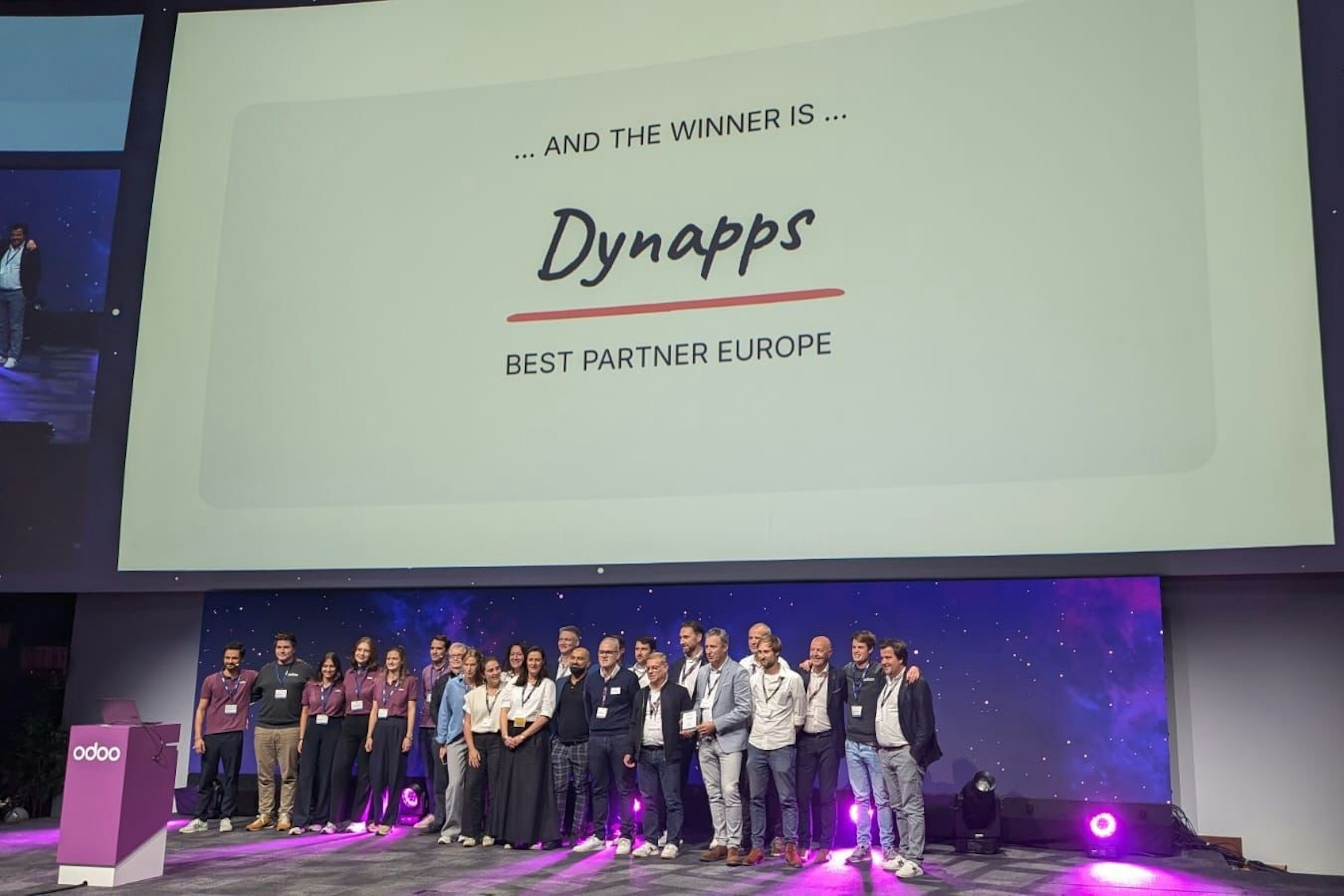
Dynapps named Best Odoo Partner in Europe
At the Odoo Experience Days in Brussels, Dynapps won the title of Best Odoo Implementation Partner in Europe, with former CEO Karel Hendrickx and the team collecting the award on 2–4 October 2024.
3 min read
Dynapps recertified to ISO/IEC 27001:2022 with zero non-conformities
Dynapps holds the ISO/IEC 27001:2022 certificate for its information security management system across its Belgian and Dutch entities. The January 2026 recertification audit closed with zero non-conformities.
4 min read
ERP vs CRM: what is the difference?
In a competitive market, businesses lean on software to operate efficiently. Two systems come up most: ERP and CRM. They serve different purposes, and they often work better together than apart.
6 min read
Odoo or Exact: which ERP fits your SME?
Choosing an ERP changes how the business runs. Odoo and Exact both target SMEs, but they solve different problems. This is a side-by-side read on functionality, flexibility, support, and where each one fits.
4 min read
Odoo vs AFAS: comparing two ERP systems built for SMEs in NL and BE
A side-by-side comparison of Odoo and AFAS, two ERP systems built for SMEs in the Netherlands and Belgium. It weighs flexibility, user-friendliness, support, integrations and cost per system.

7-minute read
Digital transformation: what it is, and how to actually do it.
Digital transformation is a worn-out phrase. Behind it sits a real question: does your business still run on disconnected tools, manual steps, and spreadsheets nobody fully trusts? This is what digital transformation actually means, why it matters, how to do it step by step, and the mistakes that sink it. Without the buzzwords.
7-minute read
Odoo AI and ChatGPT: how AI works in your ERP.
Since Odoo 19, AI sits inside the apps you already use, with your own data. What agents do, what Odoo 20 changes, what it costs and where to start.

5-minute read
Odoo vs Dolibarr: which ERP fits your business?
Odoo and Dolibarr are both open-source ERPs, but they aim at different companies. Dolibarr keeps things simple for very small organisations. Odoo goes deeper and scales further. Here is a fair comparison, so you can match the tool to where your business is heading.
5 min read
How Odoo helps you grow and manage your business
Every growing business hits the same wall: the tools that got you here stop keeping up. Separate systems for sales, invoicing, and stock start costing more time than they save. This is how Odoo helps you run and grow the business from one platform, without the overhead of a heavy ERP.