
Odoo for financial services.
Our practice spans accounting and bookkeeping firms, financial holdings with cross-country consolidation, insurance brokers, and law firms across our five European markets. Multi-company architecture, Peppol-ready invoicing and ISO 27001 hosting on one platform, with the configuration discipline that decides whether Odoo holds up under audit.
Gold
Odoo partner
880+
customer references
280+
Odoo experts

Trusted across accounting, holdings, insurance and legal operations






Industry knowledge
We understand what the financial sector actually carries. That's why it works.
Accounting firms managing dozens of SME clients, multi-entity holdings with cross-country consolidation, insurance brokers managing books of business across carriers, and law firms tracking matters and trust funds each operate in their own way. What they share is the same hard reality: client data carries strict GDPR scope, regulatory mandates land on hard deadlines (the Belgian Peppol B2B mandate effective January 2026, French factur-X phasing through 2027, Spanish VeriFactu and SII), and the compliance posture is no longer something you adjust after the implementation closes.
E-invoicing is no longer optional.
Belgium made Peppol B2B e-invoicing mandatory from January 2026. France phases in Factur-X through 2027. Spain runs VeriFactu and SII. The Excel-and-email approach to client invoicing is on its way out, and accounting firms that don't have an answer for every client by the deadline will spend the rollout in damage control. The platform that handles all three regimes natively is the one that scales the mandate without manual workarounds.
Multi-client isn't one big folder.
Accounting and bookkeeping firms running dozens of clients on Excel-and-folder structures hit the same wall: per-client confidentiality, per-client reporting, per-client compliance. One platform with proper multi-company architecture and per-client security groups is the difference between scaling the firm and capping it. The configuration discipline decides whether ten clients works, or ten clients turns into ten Excel-and-prayer islands.
Sensitive data needs structure.
Financial and legal client data sits at the strictest end of GDPR. Audit trail on access, retention rules per category, data-subject request workflows, and ISO 27001 controls on the operational side are no longer nice-to-have. The platform that has those built in, with the security model designed properly, is the one that holds up when the compliance officer asks the next question.
One platform for client work, the books and the compliance posture.
Dynapps is an Odoo implementation partner. We are not an accountant, a broker or a law firm. What we bring is the configuration that makes Odoo work for financial service providers: multi-company architecture for accounting firms managing dozens of clients on one platform, multi-entity consolidation for financial holdings across countries, Peppol access-point integration for the Belgian B2B mandate and the European e-invoicing wave, and ISO 27001 hosting for the security posture this sector demands. Your consultant configures these to the specifics of your operation, so you are not buying generic ERP and hoping it fits a regulated sector.
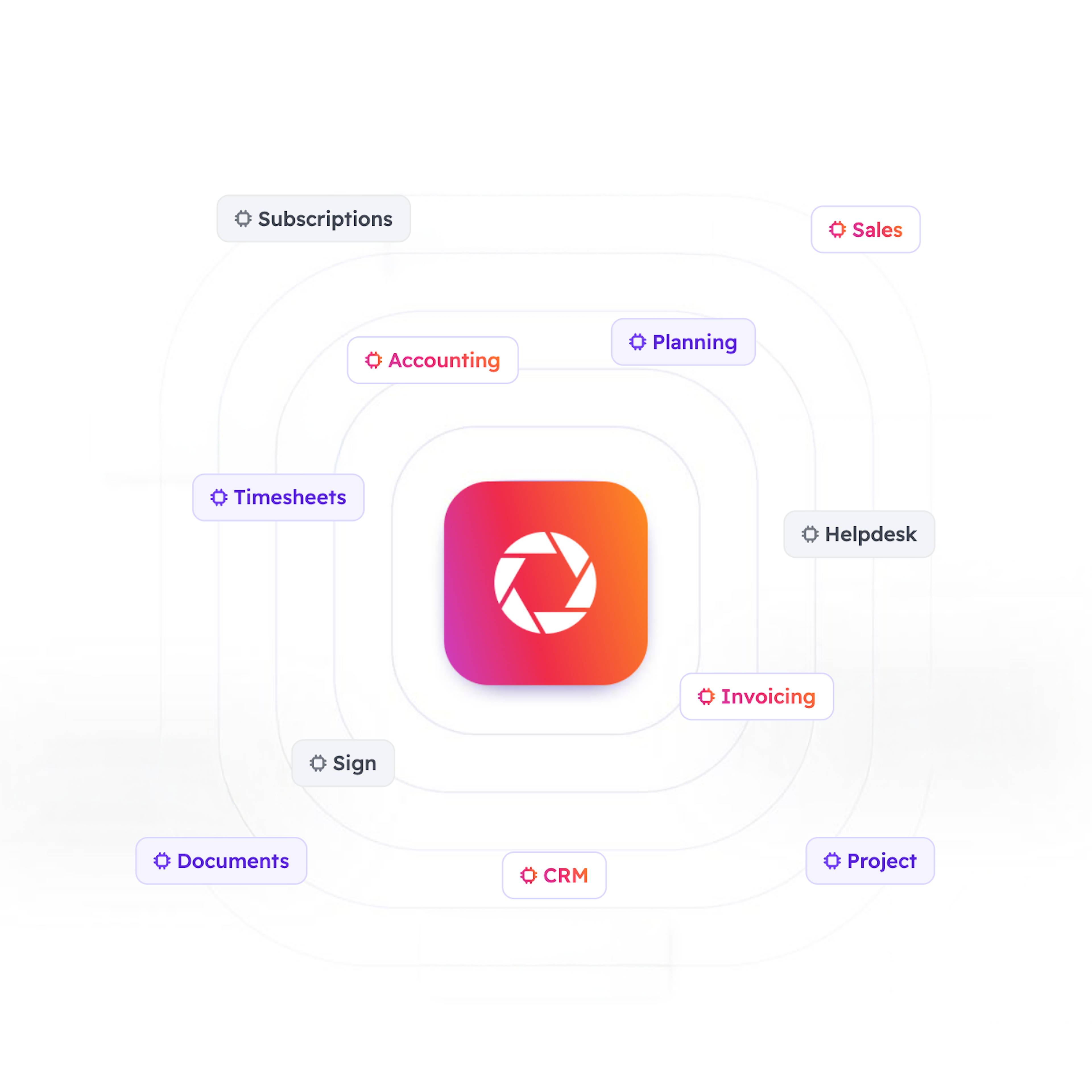
A proven approach. Your dedicated team.
End-to-end Odoo solutions for financial services, insurance and legal operations, from the first conversation to ongoing optimisation.
Discovery
We dive into your operation: client structure, fee model, chart of accounts strategy, multi-entity scope, e-invoicing regime, and the compliance posture that applies (GDPR, ISO 27001, Peppol mandate per market). We identify the configuration choices that determine whether the implementation scales, and define a roadmap that includes the security and audit-trail work, not just the software work.
Configuration
We translate your operation into the platform: multi-company architecture with per-client or per-entity security, chart of accounts and reporting templates, Peppol access-point integration, bank-feed automation with rule-based reconciliation, and the security model that matches your compliance posture. We validate with your finance and compliance leads against real scenarios.
Go-live and training
We implement, migrate and run pilot cycles against actual client or entity workflows. Staff get the training they need to be confident from day one, with the platform and the SOPs aligned, not in conflict. For accounting firms, we phase the client migration so the firm scales the rollout without losing operational continuity.
Continuous improvement
We keep improving as you grow, monitoring usage and gathering feedback from finance and compliance teams. Adding clients or entities. Layering new e-invoicing regimes as European regulation rolls out. Extending the reporting framework. Each change runs through change control so audit trail integrity stays intact.

Our success stories
Real results in financial services, insurance and legal.
- Financial services

Financial services
One Odoo backbone, from 100 to 36,000 leased bikes
Cyclis Bike Lease grew from a four-founder startup in Hasselt to 36,000+ leased bikes. Dynapps replaced the founders’ DIY setup with a single Odoo platform that scales with the business.
- Financial services

Financial services
How Régie Châtel runs every PPE assembly on one platform
A Swiss family agency runs more than 100 condominium administrations on a single custom platform built with Dynapps. It replaced a workflow of Word mail-merges and Excel trackers.

Odoo has become a fully mature accounting platform, ready for the most demanding finance teams.
Maarten Gerits
Finance expert at DynappsIndustry challenges
Challenges we see most in financial services, insurance and legal.
Multi-client setup hitting its limits.
Started with a handful of clients, now running forty or fifty with overlapping fiscal years and no per-client security model. Staff lose hours a week to context-switching. Common in growing accounting firms.
Holding consolidation by Excel.
A multi-entity holding where each company runs its own ERP. The controller rebuilds group consolidation in Excel every month, with reconciliation errors nobody traces. Common in PE-backed holdings and family groups.
An Odoo that drifted on the compliance side.
Already on Odoo, but the chart of accounts grew organically, multi-company config has gaps, Peppol was never finished and GDPR controls are loose. A take-over starts with chart integrity, security and audit trail.
At a glance
Dynapps in numbers.
A few metrics that illustrate our scale, experience and reliability as your Odoo partner.
Gold
Odoo partner worldwide
900+
references worldwide
25+
references in your industry
280+
Odoo experts
05
countries
Everything you need to know about Odoo for financial services.
Can't find the answer you're looking for? Please reach out to us.
Yes. Odoo's multi-company architecture supports accounting and bookkeeping firms running tens or hundreds of client companies on one platform, with strict per-client data separation through configured security groups. Each client is a separate company in Odoo with its own chart of accounts, fiscal year, tax configuration, and bank accounts. Firm staff work across clients from one interface with access governed by role-based permissions. Clients access their own data through the portal with the firm controlling the level of visibility (read-only reporting, document upload, invoice approval). Shared master data (chart of accounts templates, tax codes, document templates) sit at firm level and propagate to clients with overrides where local situations require. The implementation work sits in the security model design, the chart-template strategy, and the client-onboarding workflow that scales without manual effort per new client.
Odoo handles Peppol e-invoicing through configured access-point integration, with one access point shared across entities or one per entity depending on the architecture. The Peppol BIS Billing 3.0 format is supported natively for both sending and receiving structured invoices. For accounting firms managing multiple clients, the access point can be configured at firm level with per-client routing, or per-client where the client owns the Peppol identifier directly.
Multi-entity financial holdings run on Odoo's multi-company architecture with distinct legal entities, currencies, charts of accounts and tax regimes within one platform. Each entity holds its own local-GAAP books; group-level consolidation aggregates across entities into the group reporting framework (IFRS or local-GAAP equivalent). Inter-company flows handle goods, services and financial transactions between entities natively, with automatic elimination at consolidation. Multi-currency configuration runs per entity with daily, monthly or fixed exchange rates as policy requires. Entity-specific reporting (local statutory accounts, tax filings) remains per-entity; group reporting consolidates without rebuilding the books in Excel. For holdings with operating companies in Belgium, Netherlands, France, Switzerland and Spain, the platform handles five tax regimes and five regulatory bodies under one master configuration. The implementation pattern is reference implementation in the largest entity, then thinner roll-out to additional entities.
Dynapps holds ISO 27001 certification, which means the operational security framework around Odoo deployment (access management, change control, incident response, hosting infrastructure) follows the 27001 controls. GDPR compliance for sensitive financial client data configures inside Odoo through user-access controls, audit trail on data-access events, configurable retention rules per data category, and data-subject request handling workflows. For multi-client accounting firms, per-client security groups prevent cross-client data exposure even within the same Odoo database. Sensitive fields can be configured for elevated access requirements (additional authentication, time-limited access, supervisory approval). Audit-trail behaviour records who accessed what when across all critical transactions. The configuration work sits in mapping the firm's GDPR posture into Odoo's permissions model, and validating the audit-trail completeness against the firm's compliance officer's requirements.
Odoo supports law firm operations through configured workflows for matter management (each case as a structured project), time tracking on billable hours with per-attorney and per-matter rates, billing logic supporting hourly, fixed-fee, retainer and contingency models, and document management with case-linked storage. Trust accounting for client funds (where applicable in the jurisdiction) runs as separated ledgers with strict segregation from operating accounts. Conflict-of-interest checking can be configured against the client and matter master data. Billing cycles run on time-and-expense capture with the option of pre-bill review by the supervising attorney. For multi-partner firms, partner-level profitability reporting consolidates across matters. The implementation work sits in the matter structure design, the billing model configuration per practice area, and the trust accounting setup where regulated.
Odoo supports insurance broker operations through configured workflows for client portfolio management (one client with multiple policies across multiple carriers), policy lifecycle tracking from quote through binding to renewal, commission calculation against carrier-specific agreements (per policy, per premium percentage, per claim experience), and claims-handling workflow from notification through carrier reporting to client communication. Renewal management triggers automated workflows for upcoming expirations, with re-quoting and re-binding tracked against the same client and policy structure. Multi-carrier reporting consolidates premium volume, commission earned, and claims experience across the broker's book. For brokers with mixed personal-lines and commercial-lines books, configuration handles both with separate workflows where the operational reality differs. The implementation work sits in modelling the carrier agreement structure and the policy data architecture.
Three concrete differences. First, financial-services-context depth. Dynapps has run Odoo at financial holdings, accounting firms, and adjacent operations across the five markets. The chart of accounts design, the multi-company consolidation, and the Peppol configuration are practice-built, not learned from documentation. Second, ISO 27001 certification matters in this sector. We hold it. The operational security framework around Odoo deployment meets the certification standard, which is meaningful for firms handling sensitive client data. Third, take-over capability in regulated financial environments. Recovering misconfigured implementations under Peppol mandates, GDPR scrutiny, or regulatory reporting requirements is a recurring engagement type. The diagnostic and remediation skill set is practice-built. Dynapps remains an Odoo implementation partner, not an accountant or a law firm. What we bring is the configuration discipline that decides whether Odoo holds up under the compliance posture this sector demands.
Turn your accounting or holding operation into a platform ready for the next mandate.
Talk to our finance experts. They'll listen to how your operation runs today, show you what's possible with Odoo, and shape a concrete plan together with your team.