Odoo vs AFAS: comparing two ERP systems built for SMEs
Choosing an ERP system changes how an organisation works, so the decision deserves research, preparation and advice. AFAS and Odoo both target SMEs in the Netherlands and Belgium. This piece sets the two side by side on features, support, integrations and cost.
Which ERP system should you choose?
An ERP system automates and connects an organisation's most critical business processes. The right ERP software builds a better workflow, so teams work smarter, faster and more efficiently. Before choosing, it helps to answer a few questions:
What functionalities are important for your organisation, now and in the future?
Is the ERP system user-friendly?
What about training and support?
Several ERP systems compete for attention, including SAP, Oracle and Microsoft Dynamics 365. Each has its own profile: some suit large companies and multinationals, others fit small and medium-sized businesses. AFAS and Odoo sit in the second group. Both vendors built their ERP software for SMEs, and both focus on the Netherlands and Belgium.
What is AFAS?
AFAS ERP software lets companies manage and automate business processes, with particular strength in HRM, payroll and financial management. It also covers project management, CRM and logistics. AFAS focuses heavily on the Dutch and Belgian markets and complies with local legal requirements. As of January 2024, AFAS had nearly 13,000 customers and 1.4 million unique users, and it scores highly on customer satisfaction.
What is Odoo?
Odoo, originally a Belgian tech unicorn, helps organisations digitise and optimise their processes in one integrated system, with modules for accounting, sales, procurement, CRM, manufacturing, inventory and more. Its modular design lets a company start small and add modules over time. Odoo is less established in the Netherlands than AFAS, but globally it counts over twelve million users.
Key features of each ERP system
AFAS is built around Finance, HRM and workflows, with CRM, projects and order management alongside. Odoo takes a different approach: it can replace up to twenty separate apps at once, such as Salesforce, Asana and Shopify, across a catalogue of 24 apps.

What does an ERP implementation partner do?
Both AFAS and Odoo work through implementation partners, and such a partner is valuable for several reasons:
Experience and expertise that make the software rollout smoother.
An efficient, best-practice approach that cuts implementation time.
Training and support, so employees get going and keep access to help with questions or problems.
Early identification of risks.
Discover the possibilities of Odoo
Running separate software packages, or unhappy with a current ERP solution? Odoo aims to digitise and optimise every process in one user-friendly ERP package.
The main benefits of Odoo
Modular: implement only the modules you need.
Integrations with other tools, such as Amazon and Bol.com.
User-friendly for beginners and advanced users alike.
Affordable and scalable.
The main benefits of AFAS
Works entirely in the cloud, via an app or on the web.
Single data entry and daily backups.
A fixed monthly fee, cancellable daily after the first year.
Continuous innovations added to the software.
A Dutch software partner; data is stored in the Netherlands under Dutch law.
ERP costs per system
Odoo: €37.40 per user per month for a personalised environment with access to all apps.
AFAS: €59 per month for two users with access to all AFAS functionality.
These prices assume you configure the systems yourself, which is worth doing carefully to get the most out of an ERP system. Bringing in an implementation partner raises the total, because you pay for a preliminary analysis, the implementation and ongoing support on top of the software.
Investing in an ERP system
The cost of implementing AFAS or Odoo depends on several factors:
Company size: larger companies often have more complex processes.
Complexity of business processes: unique processes need customisation, which raises cost.
Existing IT infrastructure: does the new system need to fit an existing IT setup?
Timeline: a rushed project usually pushes the price up.
So the investment varies widely from company to company. A multinational with several locations, complex processes and heavy customisation needs a larger ERP budget than a small business with simple processes.

What are the key differences between Odoo and AFAS?
1. Flexibility
Odoo is an open-source platform, so its core is freely available and companies can adapt the software to their own needs. AFAS is a closed system, which limits customisation and can be restrictive for companies with specific requirements.
2. User-friendliness
Odoo has a modern, user-friendly interface, while AFAS is more traditional. That makes Odoo more accessible to both technical and non-technical users.
3. Support
AFAS is known for its customer service, with 75 employees handling customer questions daily. Odoo works through authorised partners such as Dynapps, who provide consultancy and support, alongside a large, active international community on its forums.
4. Integrations
Odoo offers integrations with external tools and platforms like Amazon and eBay. AFAS concentrates on the Dutch market, with integrations to Dutch tools and services.
ERP system chosen? That's just the beginning
Choosing the system is the easy part. Implementation is the real transition, and it takes a serious investment of time and resources: the right package, one or more skilled consultants, support inside the organisation and a solid project plan. An implementation partner like Dynapps brings the expertise, experience and support to integrate the software well. It stays a partnership, though, so both sides work together. Good preparation pays back many times over.
See what Odoo could look like for your business.
A first conversation to see if there is a match, and a demo shaped around your processes.
More posts like this
4 min read
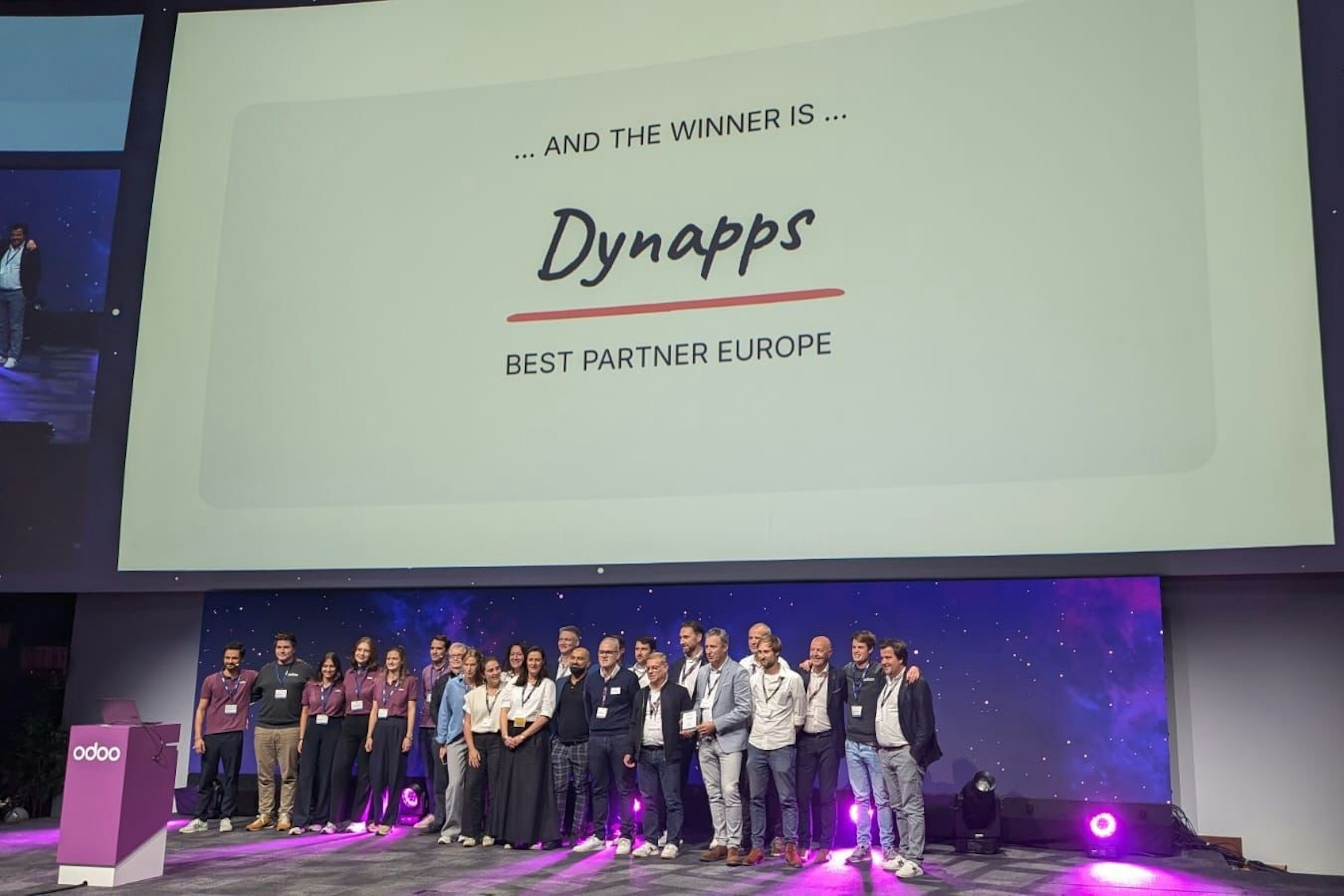
Dynapps named Best Odoo Partner in Europe
At the Odoo Experience Days in Brussels, Dynapps won the title of Best Odoo Implementation Partner in Europe, with former CEO Karel Hendrickx and the team collecting the award on 2–4 October 2024.
3 min read
Dynapps recertified to ISO/IEC 27001:2022 with zero non-conformities
Dynapps holds the ISO/IEC 27001:2022 certificate for its information security management system across its Belgian and Dutch entities. The January 2026 recertification audit closed with zero non-conformities.
4 min read
ERP vs CRM: what is the difference?
In a competitive market, businesses lean on software to operate efficiently. Two systems come up most: ERP and CRM. They serve different purposes, and they often work better together than apart.
6 min read
Odoo or Exact: which ERP fits your SME?
Choosing an ERP changes how the business runs. Odoo and Exact both target SMEs, but they solve different problems. This is a side-by-side read on functionality, flexibility, support, and where each one fits.
7-minute read
Digital transformation: what it is, and how to actually do it.
Digital transformation is a worn-out phrase. Behind it sits a real question: does your business still run on disconnected tools, manual steps, and spreadsheets nobody fully trusts? This is what digital transformation actually means, why it matters, how to do it step by step, and the mistakes that sink it. Without the buzzwords.

5-minute read
Odoo vs Dolibarr: which ERP fits your business?
Odoo and Dolibarr are both open-source ERPs, but they aim at different companies. Dolibarr keeps things simple for very small organisations. Odoo goes deeper and scales further. Here is a fair comparison, so you can match the tool to where your business is heading.
5 min read
How Odoo helps you grow and manage your business
Every growing business hits the same wall: the tools that got you here stop keeping up. Separate systems for sales, invoicing, and stock start costing more time than they save. This is how Odoo helps you run and grow the business from one platform, without the overhead of a heavy ERP.

6-minute read
The benefits of using Odoo for supply chain management
A supply chain works when information, stock, and money move together. It breaks when they live in separate systems that do not talk. This is how Odoo pulls supply chain management into one platform, and where the real benefits land.
8-minute read
What does it mean to be an Odoo Gold Partner?

6-minute read
Time tracking in Odoo: how it works.